Wide Field Imaging at Mount Kent
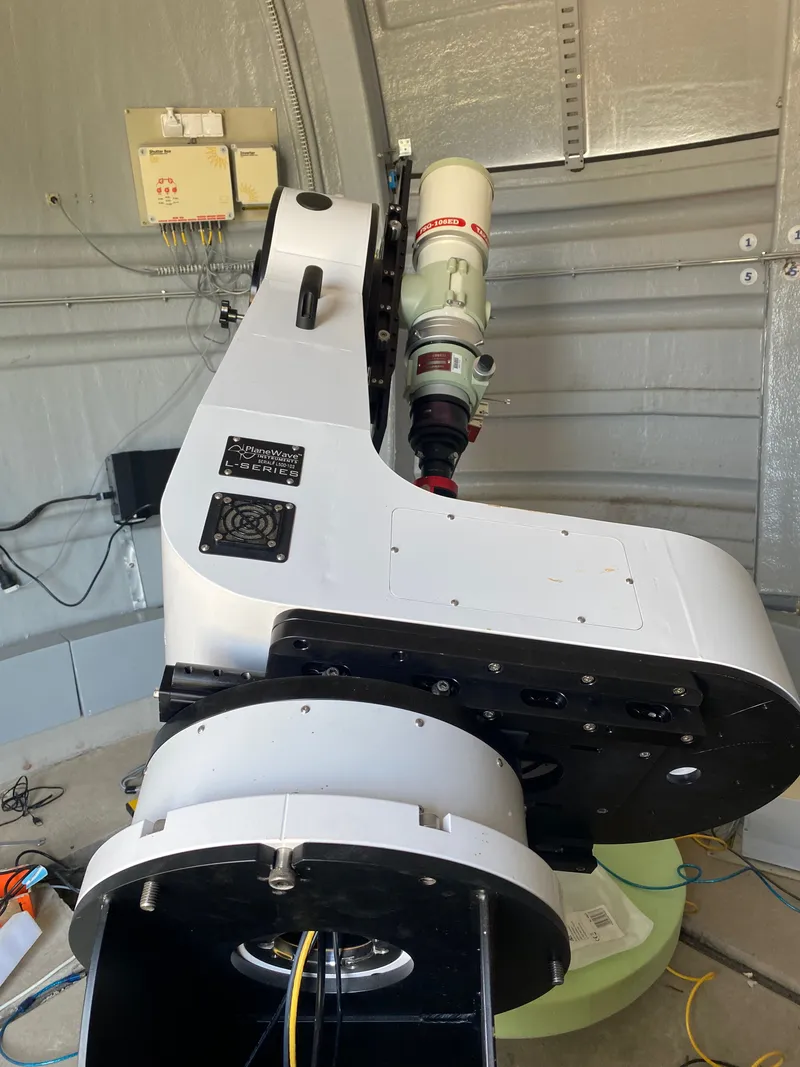
The Takahashi FSQ-106ED is a flat-field super Petzval quadruplet astrograph with 2 "ED" low-dispersion elements for high order color correction. With an effective aperture of 106 mm and an f/5 focal length of 530 mm, it resolves 1.1 seconds of arc over an 88 mm diameter image field. The optics perform well with color imaging sensors for wide field pictoral imaging, and sensitive science broadband monochromatic imagers for quantitative photometry using filters. Its fast f/5 focal ratio makes imaging of extended diffuse emission effective in reasonable exposure times. When the optical system is on a precision mount with accurate pointing and alignment, a sequence of short exposures may be co-added to produce the equivalent of hours of data collection, even extending over serveral nights. The aperture of this astrograph is sufficient to resolve to the seeing limit for typical nights over exposures from seconds to hours. While the aperture limits the detection of faint stars, the fast f-ratio enables imaging extended sources such as nebulae and comets very efficiently.
We had developed a remotely operable wide field imaging system for use in the O'Mara dome with its Paramount. A color imaging camera, and a live integrating video camea were mounted in tandem with the astrograph so that remote operators would see an acquisition field, could take color images of the wider star field and constellations, and then integrate with automation over a field of a few degrees for hours. However, the dome mechanism did not operate reliably at that time, and the project was not fully realized. In 2025, USQ relocated the astrograph to a Planewave L-mount which interchangeably accomodates a 12.5-inch telescope. In this new configuration, it is providing live remote observing to students through a web-based interface.
With a ZWO ASI 6200 camera, a pixel is 1.5 arcsecond. The horizontal field of view is 36 mm, 3.9°.