Mount Kent Observatory 0.7-meter Corrected Dall-Kirkham Telescope
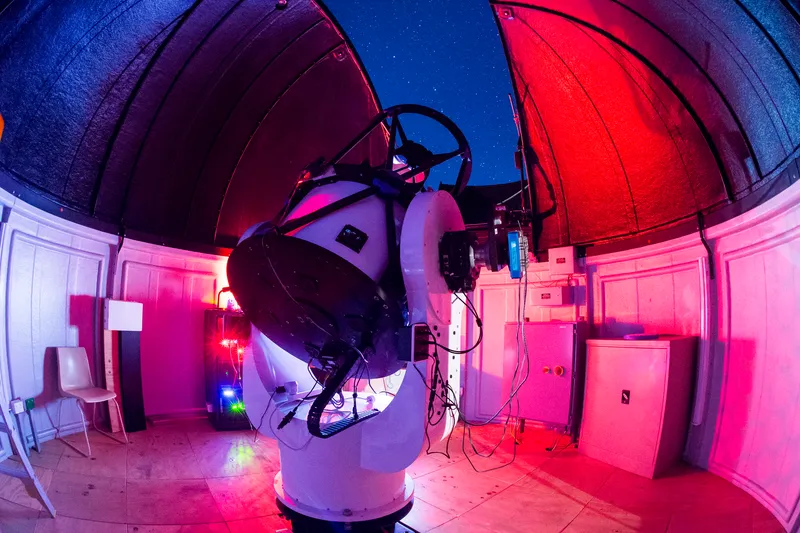
The CDK700 is a 27-inch, state-of-the-art, corrected Dall Kirkham telescope. On a Nasmyth mounting with precision encoders, it can point anywhere in the sky within a few seconds, to a precision of a few seconds of arc. The telescope has two focal positions. One is for imaging and photometry with a CMOS camera and filters, and the other is planned for spectroscopy with an echelle spectrograph.
The telescope was designed and manufactured by Rick Hedrick at Planewave Instruments, and installed with his help at Mt. Kent observatory in August 2013 in a temporary dome. It was moved to this larger new dome in 2015. It will be in routine operation for teaching and research in the third quarter of 2016.
For imaging and photometry, a ASI ZWO 6200 CMOS camera with a 9576×6388 array of 3.76 μm pixels is at a CDK700 prime focus where an automated image derotator permits high quality, long exposure, wide field imaging. The camera uses a Sony IMX455 back-illuminated low-noise sensor that oversamples the seeing and provides a wide dynamic range wth part-per-thousand precision for stars brighter than 12th magnitude. In this mode, the telescope contributes to the discovery and confirmation of extrasolar planets as a facility for the TESS Exoplanet Followup program. The camera filter wheel provides the Sloan filter set g',r', i, z' for photometry, with optional narrowband interference filters including SII, Hα, OIII, and Hβ for imaging. With the change from CCD to CMOS technology, the telescope now has capability for exposure times of millisecond scale and can use lucky imaging methods to achieve high angular resolution by selecting the best images with ideal seeing. In phtometry mode, the sub-arcsecond CMOS pixels oversample the image point-spread function, and by summing their signal bright stars may be measured with improved signal-to-noise ratio.
This CDK700 is the first of its kind, a production prototype for the 4 CDK700s in the Minerva Array at Mt. Kent. It is used now for onsite and assisted remote observing. Technology to enable safe and reliable fully remote observing is under development with high priority to be available for observing during the southern winter of 2026.