Moore Observatory's 24-inch (0.6-meter) Ritchie-Chrétien Telescope
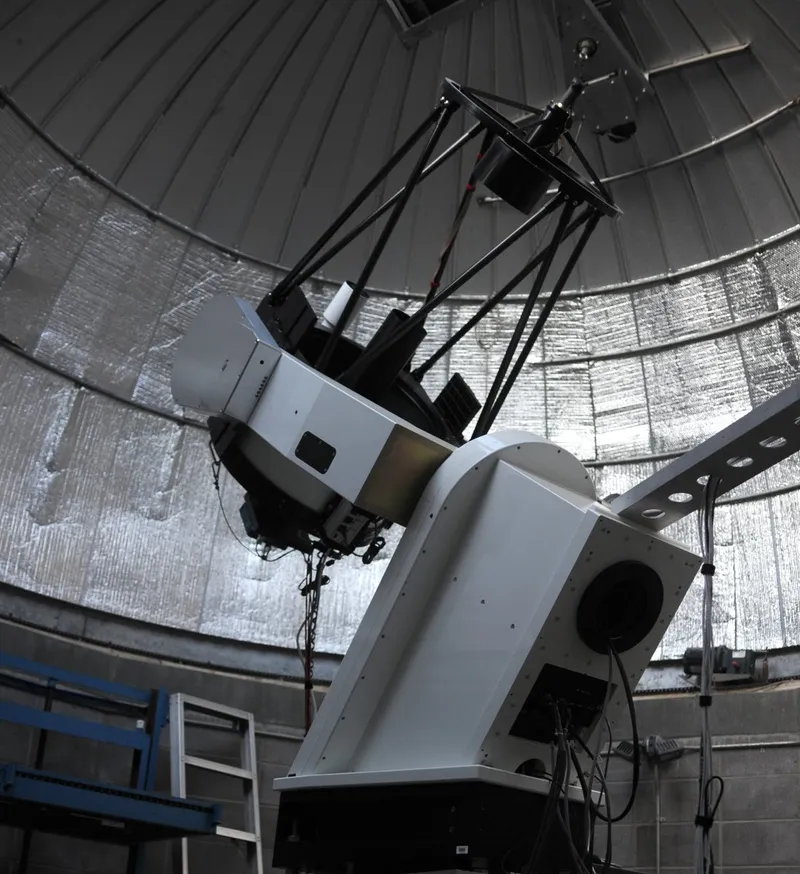
The 24-inch (0.6-meter) Ritchie-Chrétien research telescope was manufactured by RC Optical Systems and installed in August 2006. It has been in routine use for imaging, photometry, and measurements of transiting exoplanets and their host stars since then.
The telescope's Zerodur optics were made by Paul Jones of Star Instruments. The f/8 system has a peak-to-valley wavefront variation of 0.242 wave, and 0.039 RMS, with a Strehl Ratio of 0.941. The mirrors have Spectrum Coatings enhanced aluminum coating with a reflectivity peaking at 96.9% at 528 nm, decreasing slightly to 95.7% at 450 and 650 nm. With efficient well-corrected optics useful from the atmospheric UV cutoff below 380 nm through the thermal infrared above 12 μm, its 0.18 arcsecond diffraction limit is achievable for visible light with millisecond "lucky" exposure times to minimize atmospheric turbulence.
The optics are configured for a focal plane nominally 255 mm behind the primary mirror cell where the image sensor or entrance aperture of an instrument is located. Precision axial translation of the secondary mirror compensates for small offsets and temperature-dependent drift of best focus. The image scale in the focal plane is 42.3 arcseconds/mm, so that 1 arcsecond corresponds to approximately 24 microns. At f/8, the telescope can focus precisely to within its diffraction limit, and matching image quality is achieved in fast lucky imaging to select the best moments of atmospheric stability. A focal plane corrector and instrument rotator are available but are not used for photometry or spectroscopy at the present time.
The robust fork mount has a Renishaw precision encoder on the polar axis that was an innovation at the time of its installation. The encoder reads the hour angle of the telescope, and the control system uses that data to maintain pointing with arcsecond precision and overcome periodic gear and motor drive errors. With its current SiTech electronics and software, the telescope acquires targets and maintains pointing with only small correctcions derived from science images from one exposure to the next. Telescope software also enables tracking low-Earth orbit satellites using their orbital elements.
For imaging and photometry, a ASI ZWO 6200 CMOS camera with a 9576×6388 array of 3.76 μm pixels is at the MORC prime focus. Its Sony IMX455 back-illuminated low-noise sensor oversamples the seeing and provides a wide dynamic range wth part-per-thousand precision for stars brighter than 12th magnitude. In this mode, the telescope has contributed to the discovery and confirmation of dozens of extrasolar planets. The camera filter wheel provides the Sloan filter set g',r', i' for photometry, with optional narrowband interference filters including SII, Hα, OIII, and Hβ for imaging.
A Takahashi FSQ106ED 10-cm astrograph with co-axial pointing was added to MORC in 2026 to provide for wide field imaging, bright star photometry, and fine guiding. This new configuration allows use of an Baches echelle spectrogaph at the main telescope prime focus. The spectrograph is being tested in the spring of 2026 to determine if it will be useful for TESS followup, and student training, as well routine research spectroscopy for other targets of opportunity.
MORC is a near-twin to Manner, the telescope we operate on Mt. Lemmon in Arizona. The prototype of both telescopes is the AZ20 altitude-azimuth mounted 0.5 meter telescope also at Moore Observatory.