Shared Skies Planewave CDK20 at Moore Observatory
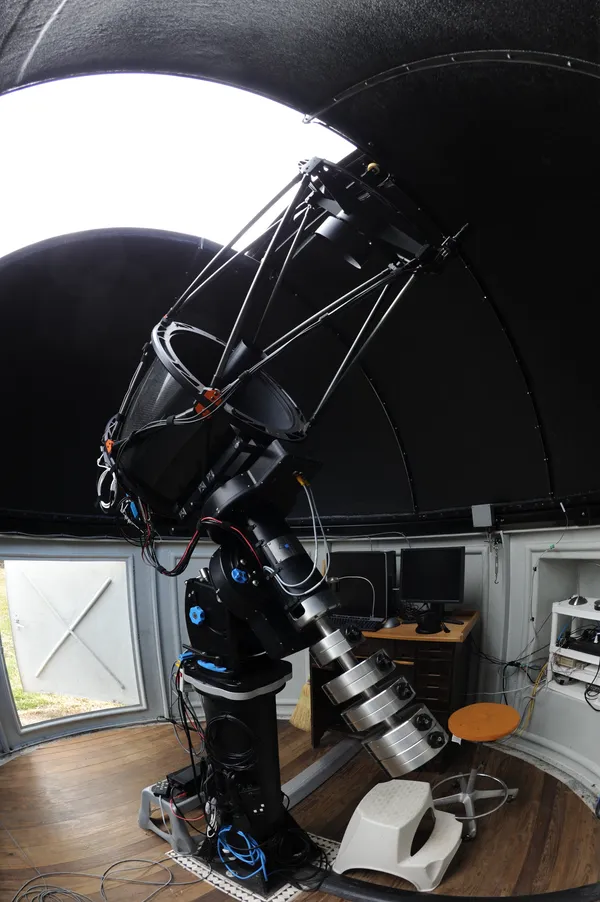
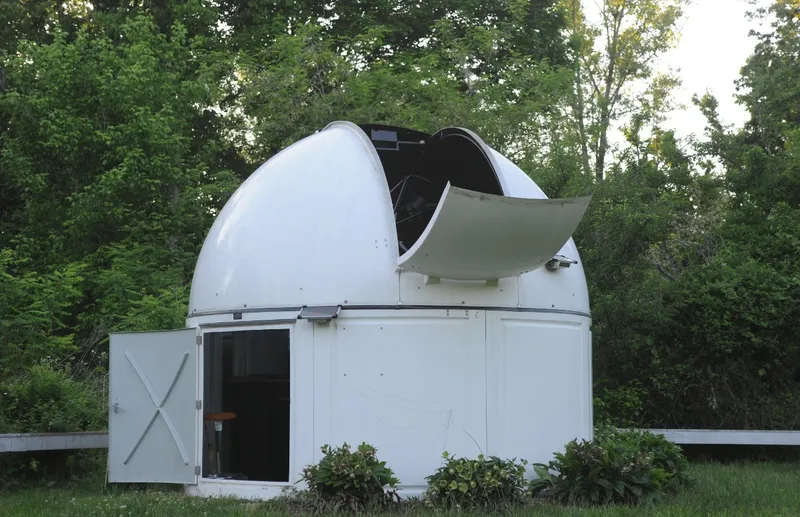
The Planewave Instruments 20-inch (0.5-meter) f/6.8 corrected Dall-Kirkham telescope at Moore Observatory in Kentucky and its identical companion at Mt. Kent Observatory in Queensland, Australia, are a unique optical design that provides a wide, extremely well-corrected, field ideal for CCD imaging and photometry.
The CDK20 North at Moore Observatory has been our primary platform for developing technology for remote and robotic operation in the Shared Skies program. The Planewave Ascension 200HR mounting seen in the photo features direct axis encoders for arcsecond positioning, and enables unguided long exposure imaging and precision photometry with both northern and southern telescopes.
The corrected Dall-Kirkham design has an ellipsoidal primary, spherical secondary, and doublet corrector. It maintains a fixed primary-secondary spacing to minimize aberrations, and focuses by moving the camera into the focal plane. The Hedrick focuser on this telescope has a motor driven encoded screw drive and is exceptionally stable. With its carbon composite truss and engineering to avoid thermal stresses, the telescope reliably maintains focus night after night within seeing tolerance unless there is a very large temperature swing. The focal scale of 60 arcseconds per millimeter provides a 36x24 arcminute field of view with the ASI 6200 camera that is its current primary detector. An Optec IFW3 filter wheel in the optical train between the corrector and the camera provides a selection of Sloan filter set (g', r', z', i') filters which are used both for photometry and for RGB imaging. Narrowband filters for selected emission lines from nebulae and stellar chromospheres are also provided on alternative filter wheels.
For imaging and photometry, a ASI ZWO 6200 CMOS camera with a 9576×6388 array of 3.76 μm pixels is at the prime focus behind the focal plane corrector. The camera uses a Sony IMX455 back-illuminated low-noise sensor that oversamples the seeing and provides a wide dynamic range wth part-per-thousand precision for stars brighter than 11th magnitude. In this mode, the telescope contributes to the discovery and confirmation of extrasolar planets as a facility for the TESS Exoplanet Followup program. The camera filter wheel provides the Sloan filter set g',r', i, z' for photometry, with optional narrowband interference filters including SII, Hα, OIII, and Hβ for imaging. With the change from CCD to CMOS technology, the telescope now has capability for exposure times of millisecond scale and can use lucky imaging methods to achieve high angular resolution by selecting the best images with ideal seeing. In phtometry mode, the sub-arcsecond CMOS pixels oversample the image point-spread function, and by summing their signal bright stars may be measured with improved signal-to-noise ratio.
Features the CDK20 North telescope include
- Fully remote operation
- Corrected Dall-Kirkham diffraction-limited optics
- Aperture of 0.5 m, focal length 3454 mm, focal ratio f/6.8
- ASI ZWO 6200 CMOS camera with 0.226" pixels and 36'x24' field
- Sloan g'r'z'i' filter wheel
- H-alpha, H-beta, [O III] narrow band filter wheel
- Encoded focuser
- Low-light sensitive monitoring camera in the dome
- Network controlled power switching
- RFID tag encoded dome rotation with autotracking software
- On site remote sensing of clouds, rain, and dew