Exoplanet Orbit and Transit Simulator
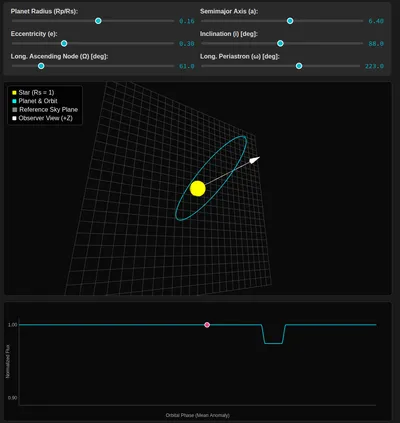
This simulation uses the geometry of an orbit as seen from space with the usual parameters that set its orientation and shape. It solves Kepler's equation to follow the planet around the host star and you will see it progress in time. When the planet passes over the star's surface as seen from the Earth, the light curve shows the transit event. The shape and timing of the event depends on the geometry as well as on the orbital physics.
A planet orbiting its host star will pass between the star and a distant observer whenever the plane of the orbit falls in the direction to the observer as seen from the surface of the star. The probability of a transit being visible from a specific star increases the smaller the orbit of the planet, and favors discovery of planets in short period orbits for which the frequency of transits is also higher.
A precision measurement of the transit light curve may be fitted with a transit model to determine the eccentricity of the oribit, the size of the orbit, the size of the planet relative to the host star, and the orientation of the orbit defined by the longitude of peristron. The light curve is insensitve to the longitude of the ascending node. When combined with precision radial velocities, the light curve yields the mass of the planet relative to the star, and the orientation of the orbit with respect to the star's rotation axis. The mass of the planet and its radius tell the density of the planet, which is our first clue to its structure. The distance of the planet from its host star determines the planet's temperature when in thermal equilibrium. Precise timing of transits over many epochs will also reveal the presence of other objects in the system with sufficient mass to alter the orbit of the planet observable through its transit.
This simulation assumes a steadily radiant star and does not include the effects of limb darkening, star spots, or faculae. Stars have turbulent noisy surfaces and are actively unsteady when they have strong magnetic fields. Some may exhibit frequent flaring, brightening randomly by many parts per thousand of their apparent radiance for seconds to minutes.
- Parameters and visualization:
- Sliders: Adjust the sliders to see immediate changes. The visualization and displayed values update dynamically.
- Keplerian Elements: The simulation accurately visualizes all five standard Keplerian elements. The rotation is performed using the standard Z-X-Z Euler sequence from the orbital plane to the observer's frame.
- Reference Elements:
- The star is the central yellow sphere.
- The planet is the cyan sphere.
- The translucent grid represents the reference plane (plane of the sky from Earth's perspective). An orbit with no inclination lies flat on this plane.
- The large arrow points in the positive Z-direction, indicating the observer's location and viewingdirection relative to the reference plane. This location determines the light curve.
- Interactivity
- Click and drag on the 3D visualization area to rotate the viewpoint and see the orbit from any angle.
- Use your scroll wheel to zoom in and out.